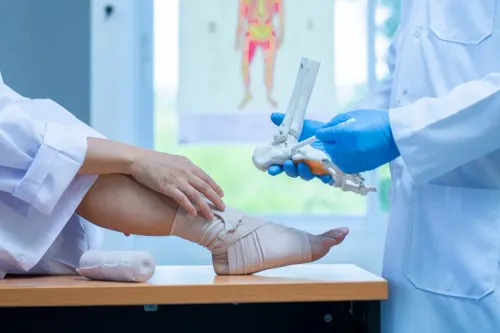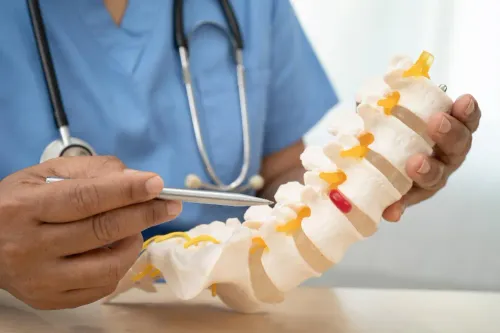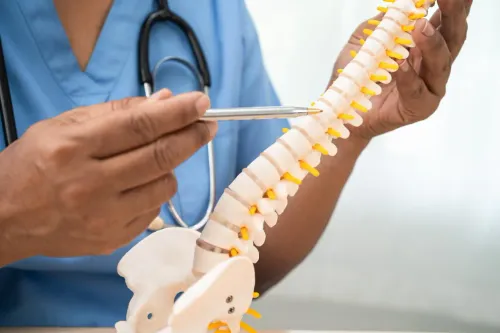
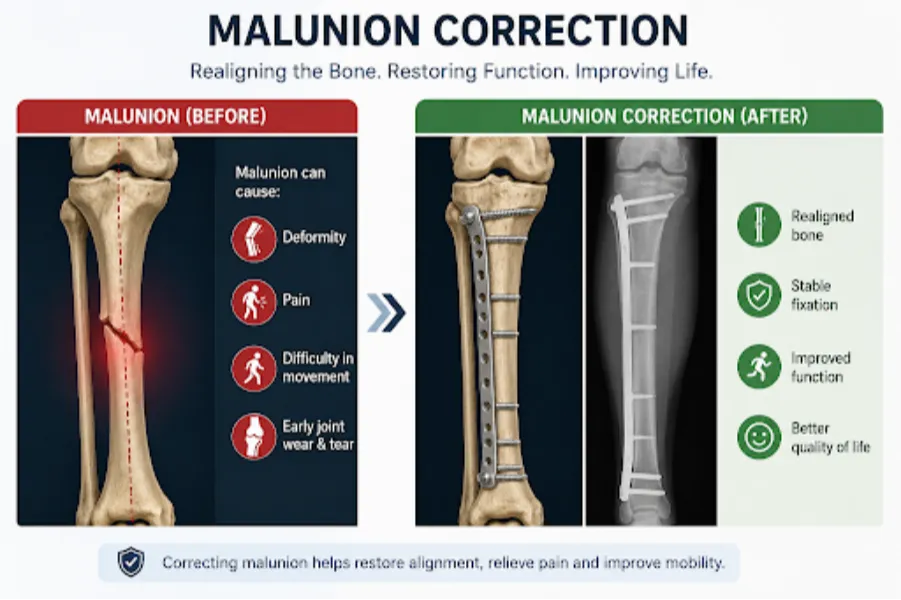
A fracture can unite successfully yet still heal in an undesirable position. This is known as malunion. Some malunions cause little functional difficulty, while others alter limb alignment enough to create pain, restricted movement, an abnormal walking pattern, or visible deformity.
At Rejoice Ortho Care And Polyclinic in Kandivali, malunion correction is considered after evaluating how the healed position affects both alignment and function.
Nonunion and malunion are different
These terms are sometimes confused.
Nonunion means the fracture has failed to heal adequately.
Malunion means the fracture has healed, but the bones have united in an abnormal position.
This distinction changes the treatment approach considerably.
When can malunion become a problem?
The significance depends on the bone involved and the degree of deformity. Possible problems include:
- Limb shortening
- Rotation of the limb
- Angulation
- Uneven joint loading
- Difficulty walking
- Restricted joint movement
- Persistent pain
- Cosmetic concerns in substantial deformities
An apparently small alignment change in one location may have greater functional consequences than a larger deformity elsewhere.
How is malunion assessed in Kandivali?
Standing X-rays and other imaging can help measure alignment. In selected cases, CT scans may be required to understand rotational deformity or complex anatomy.
The clinical assessment is equally important. The surgeon observes walking, limb position, nearby joint movement, muscle function, and the patient's actual limitations.
When is correction considered?
Surgery is generally considered when the deformity creates meaningful symptoms or is expected to compromise function. Corrective procedures may involve cutting and realigning the healed bone, followed by fixation in the improved position.
Not every radiographic imperfection needs correction. If a patient functions comfortably and the alignment is acceptable, observation may be preferable to another operation.
The key question is therefore not simply, 'Is the X-ray normal?' It is whether the healed position is affecting the patient's movement, comfort, joint mechanics, or long-term function.
Keywords